

Description
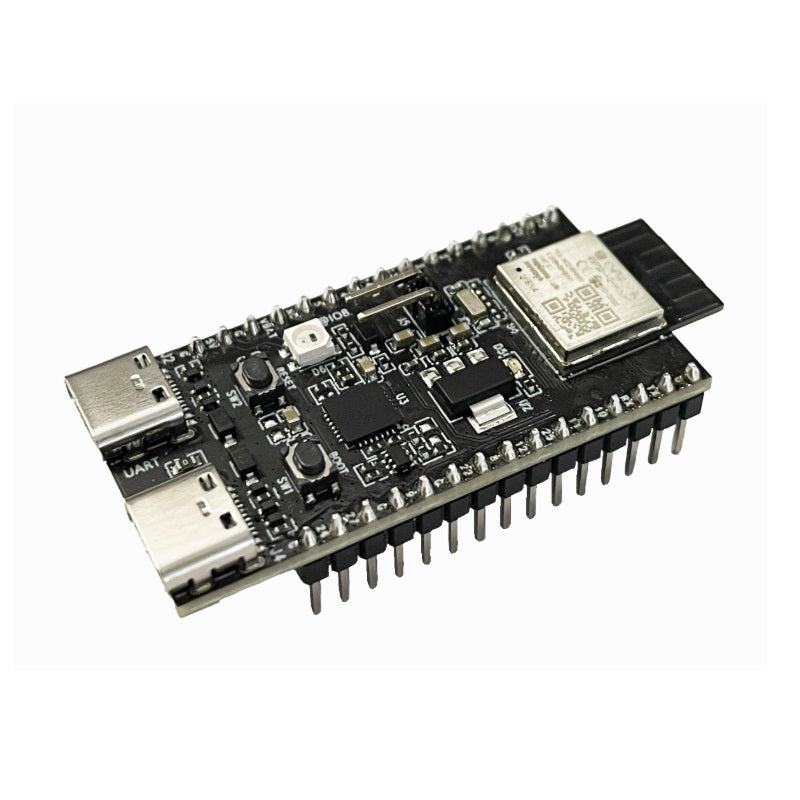
ESP32-H2-DevKitM-1 is an entry-level development board based on Bluetooth® Low Energy and IEEE 802.15.4 combo module ESP32-H2-MINI-1 or ESP32-H2-MINI-1U.
Most of the I/O pins on the ESP32-H2-MINI-1/1U module are broken out to the pin headers on both sides of this board for easy interfacing. Developers can either connect peripherals with jumper wires or mount ESP32-H2-DevKitM-1 on a breadboard.

|
Key Component |
Description |
|---|---|
|
ESP32-H2-MINI-1 or ESP32-H2-MINI-1U |
ESP32-H2-MINI-1/1U, with ESP32-H2 inside which integrates a 2.4 GHz transceiver compliant with Bluetooth ® Low Energy and IEEE 802.15.4-based technologies, supporting Bluetooth 5 (LE), Bluetooth mesh, Thread, Matter, and Zigbee. This module is specially designed for all kinds of low-power IoT applications. |
|
Pin Headers |
All available GPIO pins (except for the SPI bus for flash) are broken out to the pin headers on the board. For details, please see Header Block. |
|
3.3 V Power On LED |
Turns on when the USB power is connected to the board. |
|
5 V to 3.3 V LDO |
Power regulator that converts a 5 V supply into a 3.3 V output. |
|
USB-to-UART Bridge |
Single USB-UART bridge chip provides transfer rates up to 3 Mbps. |
|
ESP32-H2 USB Type-C Port |
The USB Type-C port on the ESP32-H2 chip compliant with USB 2.0 full speed. It is capable of up to 12 Mbps transfer speed (Note that this port does not support the faster 480 Mbps high-speed transfer mode). |
|
Boot Button |
Download button. Holding down Boot and then pressing Reset initiates Firmware Download mode for downloading firmware through the serial port. |
|
Reset Button |
Press this button to restart the system. |
|
USB Type-C to UART Port |
Power supply for the board as well as the communication interface between a computer and the ESP32-H2 chip via USB-to-UART bridge. |
|
RGB LED |
Addressable RGB LED, driven by GPIO8. This means that all color data is transmitted serially through a single data line (GPIO8) to control the color of the RGB LED. |
|
J5 |
Used for current measurement. See details in Section Current Measurement. |
|
32.768 kHz Crystal [A] |
ESP32-H2 supports an external 32.768 kHz crystal to act as the Low-Power clock. This external Low-Power clock source enhances timing accuracy and consequently decreases average power consumption, without impacting functionality. |

Documentation
- ESP32-H2 Datasheet (PDF)
- ESP32-H2-MINI-1/1U Datasheet (PDF)
- ESP32-H2-DevKitM-1 Schematics v1.3 (Applies to boards of and after PW-2024-02-0362) (PDF)
- ESP32-H2-DevKitM-1 Schematics v1.2 (Applies to boards before PW-2024-02-0362) (PDF)
- ESP32-H2-DevKitM-1 PCB Layout (PDF)
- ESP32-H2-DevKitM-1 Dimensions (PDF)
- ESP32-H2-DevKitM-1 Dimensions source file (DXF)