


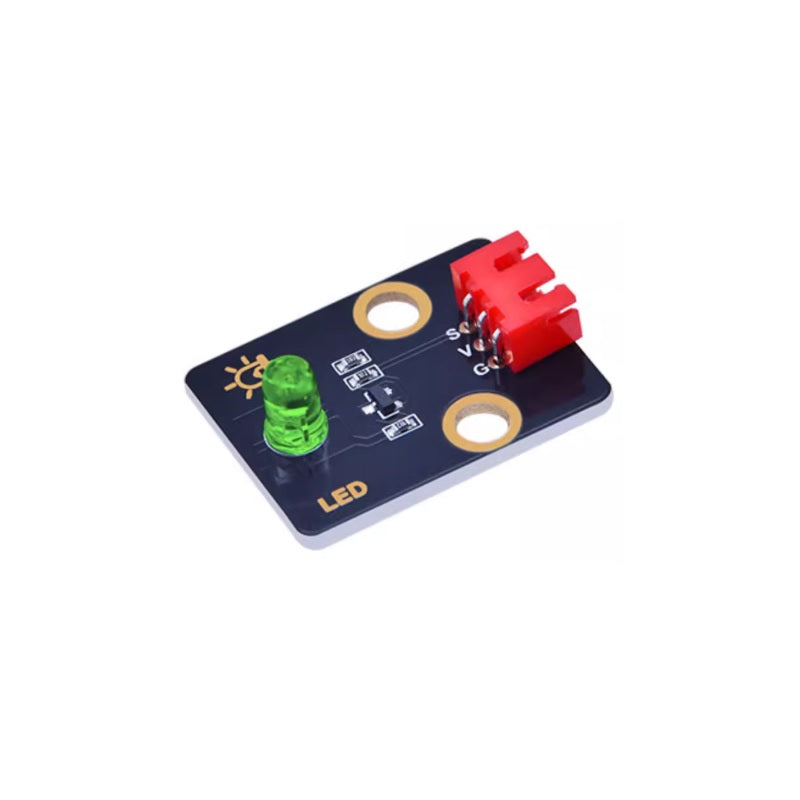
Description
The Keyes 2021 New DIY Electronic Brick LED Module is a high-quality component designed for electronics enthusiasts and educators. Manufactured with eco-friendly materials that align with modern sustainability principles, this module ensures safety and durability. Its user-friendly connection design enables quick integration into various electronic projects, making it suitable for education, experimentation, and DIY creative activities. The white LED delivers bright illumination, making it ideal for multiple application scenarios.
Features
- Eco-Friendly Material: The LED module uses black eco-friendly materials that meet safety standards, suitable for various applications.
- High Brightness: Equipped with an F5 cool white LED that provides high-intensity white light, ideal for indicator lights or illumination.
- Anti-Reverse Interface: Features a 2.54mm red anti-reverse connector to prevent incorrect wiring and enhance operational safety.
- Compatibility: Compatible with various microcontroller boards (e.g., Arduino, Raspberry Pi), allowing flexible integration into different projects.
- Easy Installation: Includes a 3-pin white anti-reverse cable to simplify wiring, making it accessible for beginners and children.
- Mounting Holes: Two 3mm Lego-compatible holes enable secure attachment to Lego bricks or other devices, enhancing modular flexibility.
Specification
- Model: KE4001
- LED Type: F5 white/red/green/blue/yellow LED
- Cable Length: 200mm
- Operating Voltage: DC 3.3V - 5V
- Interface Type: 2.54mm 3-pin anti-reverse interface
- Mounting Hole Size: 3mm diameter
- Control Signal: Digital signal
- Dimensions: 32mm x 23.5mm
- Power Consumption: Approx. 20mA (at 5V operation)
Working Principle
The LED module operates based on digital signal control. Its working principle is as follows:
- Power Connection: The module connects to a power supply via GND and VCC ports, supporting an operating voltage range of 3.3V to 5V. A stable power connection ensures proper LED functionality.
- Signal Control: The signal pin (S) receives input from a controller. A high-level signal turns the LED on, while a low-level signal turns it off.
- PWM Dimming: Supports Pulse Width Modulation (PWM) technology, allowing users to adjust brightness by modulating the signal duty cycle. This enables effects like gradual brightening/dimming or breathing lights.
- Connection Configuration: The module's design facilitates quick assembly and disassembly. The red anti-reverse connector and matching cable ensure safe and efficient connections, minimizing damage risks from incorrect wiring.
Pin Description
| Pin Name | Description |
|----------|---------------------------------------------------|
| VCC | Positive power supply (3.3V to 5V input) |
| GND | Negative power supply connection |
| S | Signal input pin for controlling LED on/off states|
- VCC: Connects to the positive terminal of the power supply. Ensure the voltage remains within 3.3V–5V to prevent module damage.
- GND: Connects to the negative terminal (ground) of the power supply, establishing a stable reference voltage.
- S (Signal Pin): Receives control signals from a microcontroller. A high-level signal activates the LED, while a low-level signal deactivates it. Users can program this pin according to project requirements.
Application Scenarios
The Keyes 2021 DIY Electronic Brick White LED Module is widely applicable in:
- Education: Used in electronics courses and practical activities to help students understand LED principles and circuit fundamentals.
- Home Lighting: Serves as simple indicator lights or auxiliary lighting with flexible mounting options.
- DIY Projects: Ideal for creative projects such as custom lamps, interactive artworks, or electronic toys.
- Experimentation: Functions as a brightness test tool or status indicator in electronic experiments for visual feedback.